
Find Pasadena Residents by Question
Pasadena has no single resident roll. The useful starting source depends on the question. A present parcel clue belongs with the Los Angeles County Assessor. A recorded ownership trail belongs with the Registrar-Recorder/County Clerk. A case clue belongs with Los Angeles Superior Court. A past household may surface first in the Pasadena Public Library’s directories, newspapers, or yearbooks. Each source describes a role, date, or connection. None proves every person who occupied an address.
A name search also needs a time frame. Match a middle initial, spouse, occupation, school, parcel number, or consistent city before deciding that two entries refer to one person. A mailing address can belong to an owner who lives elsewhere. A permit can name an architect or contractor. A directory can omit a lodger or use a spouse’s name. The strongest Pasadena resident lookup is a short chain of independent records, with the custodian and date kept beside each clue.
- Start with the assessor’s parcel search when an address or nearby landmark is known. Record the AIN, situs address, and legal-description shorthand.
- Use California’s voter-status tool only for the voter’s own authenticated registration check. It is not a public name or street directory.
- Move from a parcel or owner clue to the county deed process. Los Angeles County indexes real-estate documents by grantor, grantee, and recording year, not by street.
- For an earlier Pasadena household, compare city directories, newspaper citations, yearbooks, census schedules through 1950, and property history.
- When a city record is not online, submit a focused request with the department, address or name, date range, and record description.
That order keeps a broad search from becoming a list of unverified names. It also makes a missing result useful: an offline deed index, protected voter record, or closed historical collection tells you which next channel to use.
Pasadena Offices Behind Resident Records
Los Angeles County and California keep most durable identity and property records for Pasadena. The county Assessor supplies parcel geography and assessed characteristics. The Registrar-Recorder/County Clerk holds recorded documents and vital-record order channels. The County’s election office controls voter-file access. Pasadena’s City Clerk, Permit Center, Public Health Department, and library add local administrative, address, and historical context.
The roles are different. The Assessor’s public portal can identify a parcel, but California law keeps the owner-name and assessed-value pairing off the public website. The recorder’s index is not online at all. The voter-status check authenticates the person checking their own registration. These limits are part of the source map, not a defect in a search.
Los Angeles County Recorder / Register of Deeds
12400 Imperial Highway
Norwalk, CA 90650
800-201-8999, option 3 for real estate
Los Angeles County Assessor
Online parcel and property tools
Owner details require an office or Data Sales route
Public portal access
Los Angeles County Election Information
12400 Imperial Highway, Room 2013
Norwalk, CA 90650
800-815-2666, option 4
Pasadena Resident Names Need Clues
A name alone is a weak key. Normalize initials and spelling, then look for a second fact that can be checked at another custodian. An exact AIN, court case number, license number, entity number, or recording document number is the best anchor. If none exists, pair a name with a middle initial and spouse, a stable city and occupation, or a date range that fits the claimed connection.
Los Angeles County’s property trail is especially easy to misread. The public parcel record may show a situs address, AIN, tract and lot shorthand, land and building fields, and an aerial view. Owner and owner mailing information are suppressed online. A mailing address is where tax notices go, not proof of occupancy. A deed supplies the legal description and named parties, but ownership still does not identify every household member.
- Roll
- A government list or set of entries, such as a parcel or voter file.
- Index
- A finding aid that points to a fuller document or case, often by name and date.
- Parcel
- A mapped piece of land identified in the assessor system by an AIN.
- Criss-cross directory
- A reverse directory arranged by address or street rather than only by surname.
Those definitions keep the evidence separate. A roll may show a status. An index may point to a deed. A parcel may locate land. A directory may describe a household at publication time.
Pasadena Resident Parcels Start With AIN
The Los Angeles County Assessor Portal is the practical first stop when an address is known. Its basic search accepts an Assessor Identification Number or address. Legal Search offers a legal-description route, and Map Search lets a researcher browse parcel geography when a typed address fails. Multi-unit, corner, newly developed, and normalized addresses can require a map pivot.
| Search control | Type | Required | Format or use |
|---|---|---|---|
| Search by AIN or Address | Text or autocomplete | Yes | Enter the parcel number or street address. |
| Basic Search | Mode/button | No | Default parcel lookup. |
| Legal Search | Mode/button | No | Search by legal-description fields; dynamic subfields vary. |
| Map Search | Mode/button | No | Browse and select parcel geography. |
The parcel result can expose the situs address, AIN, tract or lot shorthand, land and building characteristics, use code, and assessment context. Owner names are deliberately withheld from the web owner-name/value pairing under California Government Code §7928.205. For that missing link, use the Assessor office or Data Sales route, then label the result as owner or mailing information rather than resident evidence.
Pasadena Deed Records Start Offline
Los Angeles County’s recorder system is unusual enough to shape every Pasadena resident lookup. The real-estate index is not published on the Internet. At Norwalk, 1851–1957 material is on the lower level and 1958–present material is on the second floor, with appointment access for index viewing. The index is alphabetical by grantor or grantee and recording year. It is not searchable by street address or AIN.
Once a name and year are known, the record can identify a document title or type, recording date, document number, party roles, and legal description. Copies are ordered through RR/CC, by mail, or through the identified online fulfillment route. Real-estate staff can explain the channel at 800-201-8999, option 3, but an open-ended telephone search is not a substitute for the index. A focused CPRA request also cannot turn a purchase-only deed copy into a public address search.
For a Pasadena resident trail, move from parcel to owner clue, then from current grantee to earlier grantor. Keep the document number and full legal description beside every step. That chain belongs to land. Directory, permit, census, and obituary evidence must be added separately when the question is who occupied the property.
The Los Angeles County recorder services page shows the office route for real-estate records and related county functions.
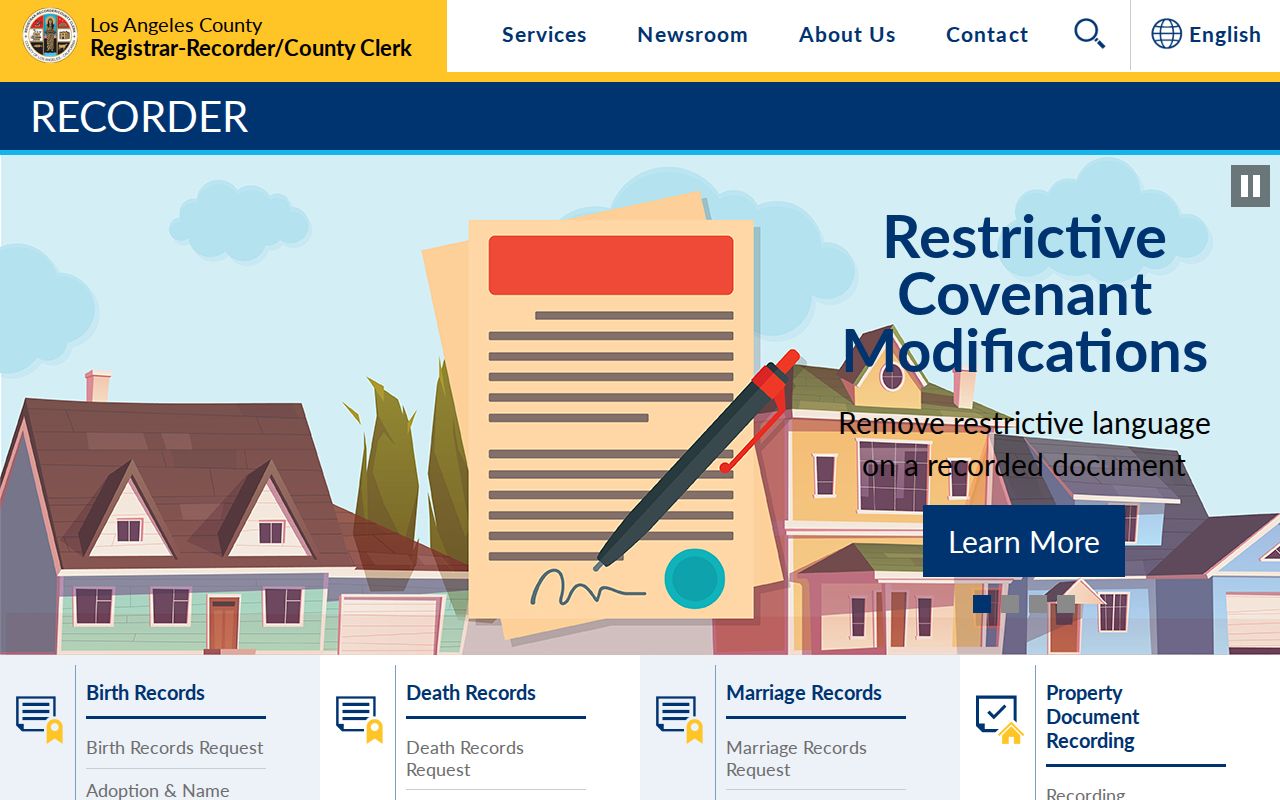
The recorder view reinforces the key point: a Pasadena deed search starts with a known party and year, then moves through an office-controlled index and copy process.
Older deed work is therefore an in-person research task. The Pasadena street directory workflow adds parcel, permit, and street context without pretending that the recorder has an address search.
Pasadena Resident Voter Data Is Limited
California’s My Voter Status service is a self-check, not a Pasadena residents directory. The authenticated form asks for last name, birthdate, house number, and ZIP Code. A successful match lets the voter inspect their own registration status. It does not enumerate a street, reveal a neighbor list, or provide a public name search.
Los Angeles County can provide certain voter information through a restricted request process. The form requires requester identity, a permitted-use statement, a security agreement, and payment. Available fields may include name and address components, registration and status dates, party, precinct, districts, permanent vote-by-mail status, and election participation. Safe at Home voters are excluded, and participation codes show whether a ballot was cast or returned, never ballot choices.
That boundary matters for a lawful personal lookup. A result from the voter-status tool is evidence of the requesting voter’s registration, not proof that every person at a Pasadena address lives there. A negative result is also weak because protected, inactive, or otherwise restricted records do not become visible through a general search.
Present-Day Pasadena Resident Sources
Current Pasadena resident clues come from records with different scopes. A parcel record is about land. A deed is about named parties to a transaction. A court index is about a case. A license or business filing is about a professional or entity address of record. A neighborhood association page identifies a civic group, not its members. The table below keeps those distinctions visible.
| Source | Who It Lists | Keeper | Access |
|---|---|---|---|
| Assessor parcel record | Land, situs, AIN, characteristics | Los Angeles County Assessor | Free web parcel search; owner suppressed |
| Voter status | The requesting voter’s registration | California Secretary of State | Free authenticated self-check |
| Recorded document index | Grantors, grantees, dates, document types | LA County RR/CC | Office index; copies paid |
| Permit and code case | Projects, inspections, cases, participants | Pasadena Permit Center | Public search; account for transactions |
| License or business record | Professional status or entity address | California DCA or SOS | Free public search; not residence proof |
| Association directory | Group name and public contact | Pasadena council district | Voluntary civic layer; no member list |
Use a parcel to orient the address, a deed to identify a recorded party, a court case to separate same-name people, and a directory or newspaper to test historical occupancy. A license, entity filing, or unclaimed-property result can add a useful city or affiliation clue, but its address may be a business or mailing location. Record the exact role shown by each custodian.
| Source style | Strength | What still needs checking |
|---|---|---|
| Official roll, index, or portal | Named custodian, stated fields, known access rules | Date, role, redactions, and whether the entry is current |
| Commercial people-search category | May combine many public and purchased datasets | Source quality, same-name merges, stale data, cost, and lawful use |
Official does not mean complete, and a compiled result does not become proof through repetition. Use the official custodian to confirm the fact that matters.
Pasadena Records Requests Fill Gaps
The Pasadena City Clerk’s public-records request form is the fallback for identifiable, nonexempt city records. It routes requests to departments such as Planning, Police, Library, Public Health, Public Works, City Clerk, and City Manager. A useful request names the address or person, the date range, the record type, and the department likely to hold it.
The form asks for a response preference, requester contact details, city and state, a specific description, and optional department selections. Delivery can be by US mail, email, in-person pickup, or fax. The description has a 2,500-character limit, and one attachment may be supplied up to 3 MB. Help is available through the City Service Center at 626-744-7311; the printable request form lists fax 626-744-4190.
The Pasadena CPRA request form shows the department-routing and response-delivery choices before a request is submitted.
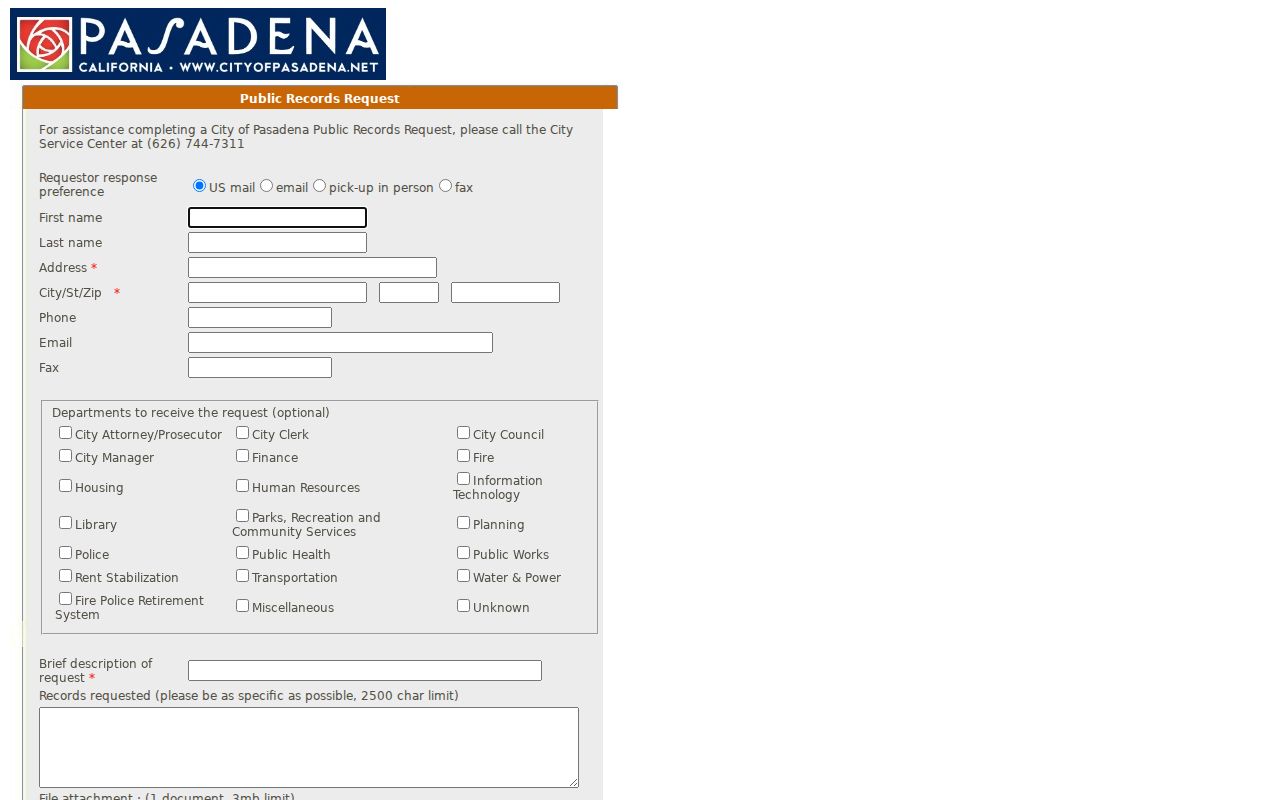
That form is more than a submission screen. Its fields help turn a vague resident question into a narrow, searchable city-record request.
California’s Public Records Act, Government Code §§7920.000–7931.000, ordinarily gives an agency 10 calendar days to determine whether it has responsive disclosable records. That is a determination window, not a promise that production will finish in ten days. The law does not force a city office to create a new resident list, and confidentiality rules still control what can be released.
For an address question, Pasadena’s Permit Center and Citizen Self Service system can add permits, plans, inspections, and code cases. An applicant may be an agent or contractor, so treat the participant as a project role. Use the city request route when an older administrative file or a nonpublic interface needs a specific records search.
Pasadena Resident Records Add Clues
California’s public license and entity tools can help separate two Pasadena names without pretending to be a resident roll. The Department of Consumer Affairs search accepts boards or bureaus, license type or number, business name, and first or last name. Its advanced filters can add registry number, license types, cities or counties, status, discipline, and public documents. A result may show status, issue or expiration dates, address of record, and discipline.
Secretary of State bizfile Online searches a business entity name or file number and can filter entity type, status, and initial filing date. Results can show an entity number, formation date, status, jurisdiction, street or mailing address, agent for service, and Statement of Information due date. They do not disclose every owner, phone, email, subsidiary, operating agreement, or EIN.
The State Controller’s unclaimed-property search offers another humane family-history lead. Last or business name or a Property ID is required; first name, city, and ZIP are optional. Exact matches appear before similar names, searching and claiming are free, and there is no deadline to claim. An old city or address association is a lead to verify, not proof of current residence.
These tools are most useful when a person’s record has a stable role. A license number, entity file number, or property ID is stronger than a broad name match. Keep the record’s address label in your notes so a business, mailing, or service location is not silently changed into a home address.
Pasadena Resident ZIP Records Narrow the Trail
ZIP Code is a helpful filter, but it is not a city boundary. Pasadena’s six core ZIPs are 91101, 91103, 91104, 91105, 91106, and 91107. Nearby Altadena uses 91001, San Marino uses 91108, and South Pasadena uses 91030. A USPS route may serve a mailing address that does not match the incorporated place shown by Pasadena’s address validator or parcel map.
USPS Postal Bulletin material groups 91114 with 91104, 91115 with 91105, and 91117 with 91107. Those numbers should be checked with the intended address and should not be treated as neighborhood ZIPs without live USPS confirmation. Census ZIP Code Tabulation Areas are statistical approximations, so a ZCTA overlap does not make every point a Pasadena address.
For a careful name or address search, verify the postal route with USPS, verify incorporation with Pasadena’s address form, then use the Assessor to recover the AIN and situs. ZIP, situs, mailing address, legal description, and AIN answer different questions. The distinction is especially important when a resident clue crosses a city line.
Pasadena’s Historical Directory Shelf
Pasadena’s historical residents directory begins with the Public Library’s Centennial Room, whose city and business directories reach back to 1880. The collection also includes yearbooks, newspapers, maps, photos, oral histories, city reports, architectural and biography notebooks, and the Pasadena Master Index. Central Library material is offsite during seismic work, so Ask Us staff and research consultations matter as much as the catalog.
The Pasadena Museum of History Research Library reports a near-complete Pasadena city-directory run from 1893 through 1976, with research access Friday through Sunday from 1 to 4 and help at research@pasadenahistory.org or 626-577-1660 ext. 205. The Altadena Historical Society’s Thurston run, digitized Moore and Thurston volumes, PCC yearbooks, newspaper citations, and Sanborn maps add different kinds of evidence.
A directory entry can connect a surname to an address, occupation, spouse, or householder mark for one publication year. It cannot establish that every household member lived there, and it cannot replace a deed or vital record. The Pasadena city directory collections hold the deeper year-by-year method.
Pasadena Resident Safety Records Have Limits
California’s Megan’s Law website is an official public registry with a legal-use warning, not a general Pasadena resident directory. Depending on the record, a search can use name, city, county, ZIP, or a park or school vicinity and may show an alias, photo, description, date of birth, conviction, category, or address information. The registry does not display every registrant, and the public rules forbid harassment.
Use an official entry only for the narrow purpose the registry allows. It is not a substitute for a court file, a current parcel record, or a personal identity match. The same discipline applies to other public-safety or custody lookups: note the keeper, date, record type, and exclusions before drawing a conclusion.
The California DOJ registry is the source for its own search rules and warning language.
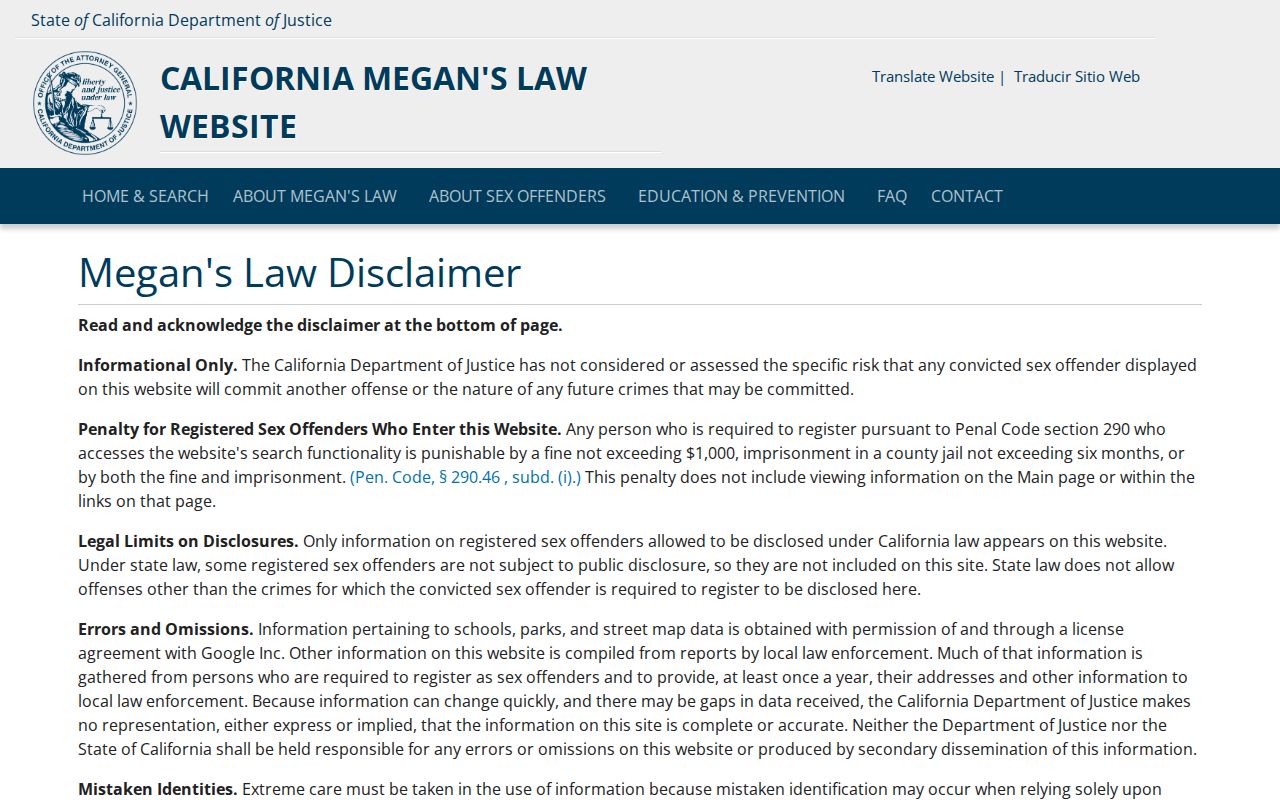
The captured registry view belongs to a state search system, which is why its fields and legal limits should not be blended with Pasadena parcel or directory evidence.
Pasadena Resident Lookup Privacy Limits
California’s Safe at Home program, Government Code §§6205–6216, supplies substitute mailing addresses and confidential voter registration for eligible people facing specified safety threats. A protected record is meant to remove a location clue. The absence of a person from a public search is not evidence that the person is absent from Pasadena.
California privacy law also distinguishes public custodians from qualifying businesses. The California Consumer Privacy Act, as amended by the California Privacy Rights Act, gives covered consumers rights to know, delete subject to exceptions, correct, opt out of sale or sharing, and limit sensitive-data use. The 2026 DROP program can send deletion or non-sale requests across registered data brokers, but it does not erase county deeds, city records, or historical library holdings.
The responsible result is modest: a named record connects a person to a role, place, or date under a stated custodian. Confirm important facts with the office that holds the record, honor confidential programs, and stop when the source no longer supports a lawful purpose.