
Pasadena's City Directory Shelves
Pasadena city directories are a distributed collection, not one complete online file. The Pasadena Public Library gives the early starting point, the Pasadena Museum of History supplies a strong later run, and the Altadena Historical Society preserves a Thurston sequence that follows the older region's wider geography. Digitized volumes, Pasadena City College yearbooks, newspapers, and Sanborn maps fill selected gaps. Access changes by repository, so the keeper and the year range belong in the research notes.
| Collection | Years covered | Where held | Access route |
|---|---|---|---|
| Pasadena city and business directories | Back to 1880 | PPL Centennial Room, now offsite during closure | Ask Us, staff research help, or appointment; 626-744-4066 |
| PMH directory volumes | Near-complete 1893 to 1976 | Pasadena Museum of History Research Library and Archives | Friday to Sunday, 1 to 4; research@pasadenahistory.org; 626-577-1660 ext. 205 |
| Thurston directories | 1911 to 1976 | Altadena Historical Society archive | Staff-assisted historical access |
| Moore and Thurston digitized volumes | 1900 and 1918 to 1919 | Pasadena Digital History Collaboration and California Revealed | Page images, surname ranges, and front matter online |
| PCC yearbooks | 1899 to 1968 | Pasadena City College Digital Archive | Searchable and downloadable online |
| Pasadena newspapers | Citations back to 1880; emphasis 1996 to present | PPL News Index and microfilm; PMH bound papers | Index citation first, then staff or microfilm for text |
| Sanborn maps | 1887, 1888, 1889, 1890, 1894, 1903, 1910, 1930 | Library of Congress online sheets; PMH physical sets | 1887 to 1903 online; 1910 and 1931 physical holdings reported |
The table shows why a collection search should name the keeper before it names a conclusion. The PPL run reaches earlier, PMH is the clearest near-complete local run, and digitized books are samples rather than a promise that every annual volume is online.
Pasadena Directories From 1880 to 1976
The local sequence begins with the library's stated directory coverage back to 1880. A verified 1888 Los Angeles directory places a Pasadena section at page 891. Moore's 1900 volume is followed by Howard and Thurston's 1903 to 1904 book. A 1910 Resident and Business Directory included government, institutions, societies, and a street directory. Thurston volumes are documented for 1912, 1918 to 1919, 1923, 1927, and 1929, while a 1919 Home Telephone and Telegraph directory adds a separate address and phone layer.
That sequence is a set of landmarks, not a claim that every year survives in one place. Repositories do not publish every annual holding, the first reverse volume, or a definitive last printed year. Searchers should note the exact title page, publisher, place labels, and coverage statement in each physical or digitized book. Historical Pasadena directories may include Altadena, Lamanda Park, Raymond, or North and South Pasadena, so a name hit can cross a present city line.
- 1880s: early library holdings and the 1888 Pasadena section establish the first local shelf.
- 1900 to 1910: Moore, Howard and Thurston, and the Resident and Business Directory broaden name, institution, and street coverage.
- 1911 to 1929: Thurston runs, telephone material, and changing regional labels provide overlapping household clues.
- 1930s to 1976: PMH and Altadena holdings carry the later printed-directory trail, subject to each archive's exact gaps.
Publishers Behind Pasadena City Directories
Publisher names help distinguish two books that look alike in a catalog. Moore's 1900 Pasadena volume is one digitized anchor. Albert G. Thurston and the Los Angeles Directory Company appear in the 1918 to 1919 Pasadena directory, whose geographic frame includes Pasadena, Altadena, and Lamanda Park. Howard and Thurston's 1903 to 1904 book and the 1910 Resident and Business Directory show how titles and contents changed as the city grew.
Publisher context also explains why a directory entry may include more than household names. The 1910 book brought government, institutions, societies, and a street section into the same volume. Telephone books, yearbooks, and newspapers then supplied different kinds of names. Keep a scan or transcription of the title page and abbreviation key with each search result. It prevents a later researcher from treating a page range, surname index, or street section as if it were the whole volume.
Note: A directory title identifies a publication's scope, but it does not prove that the same publisher or geography continued in the next year.
Digitized Pasadena Directory Volumes
The Pasadena Digital History Collaboration places selected local books and stories in a shared digital setting. The 1900 Moore volume and the 1918 to 1919 Thurston directory are valuable because they let a researcher inspect page layout, surname ranges, front matter, and the way historical geography is named. A digitized page can confirm a transcription, but a missing year online does not mean the person or address was absent from print.
A Pasadena Digital History directory collection view shows how these local materials are presented across institutions.
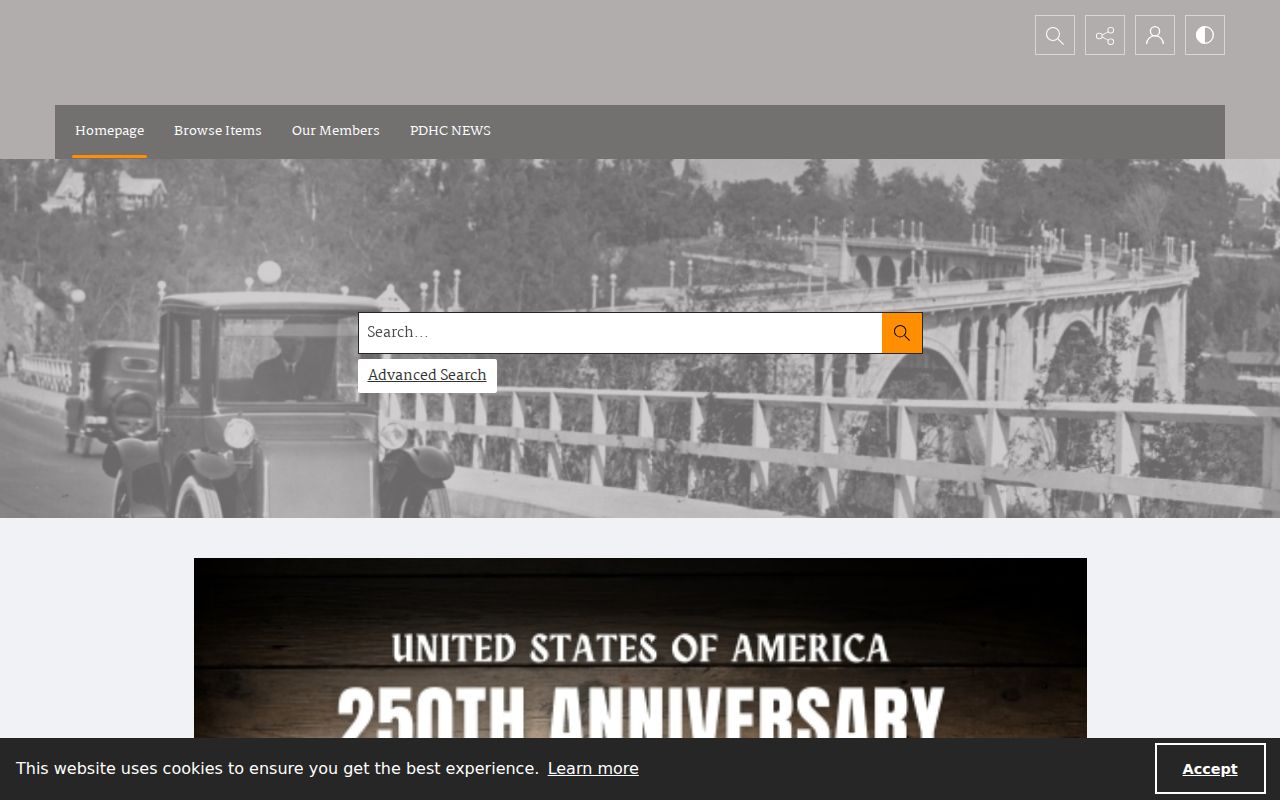
The digital interface is best used to learn a volume's structure and verify a page image before requesting help with a physical run.
The Calisphere Pasadena collection provides another route into digitized local-history material. Browse by collection context, then save the title, year, page, and image URL in the research notes.
Calisphere is a discovery layer, not a substitute for the repository record. The volume's own title page and coverage note remain the best check on what a page can establish.
Decode a Pasadena City Directory Entry
A Pasadena city directory entry is compact. It may combine a person's name, occupation, spouse or widow notation, street address, and a small mark that changes the meaning of the line. The entry was made for a publication year, so the address and household status must be read as a dated clue. Preserve the spelling and punctuation before expanding an abbreviation.
| Name | Householder or named resident; a spouse can appear in parentheses. |
|---|---|
| Occupation | Historical identity clue that can separate people with the same name. |
| Address | House number and street, sometimes with a direction or a neighborhood label. |
| Household mark | Some volumes distinguish a householder, a boarder, or a residence entry. |
| Widow notation | A widow or spouse note can connect a directory line to news, probate, or an obituary. |
One inspected sample lists George B. Post at 257 Grand Avenue in 1900. Another series lists Eugene F. Sacket as “plumber, r 350 N Raymond av” in 1914, 1917, and 1921, then “(Jean B), plumber, h 291 E Villa” in 1923. The research interpretation treats r as likely residence or rooms and h as likely householder or home. Confirm those meanings in the specific volume's key before using them.
- Criss-cross directory
- The street-order portion of a directory, used to move from an address to listed names.
- Householder index
- An index centered on the named person responsible for a household line, not a complete list of every adult at the address.
- Abbreviation key
- The volume's explanation of short marks such as
randh; photograph or transcribe it first. - Index versus entry
- An index points to a surname or page, while the entry supplies the address and context.
Pasadena Directory History and Grand Avenue
The George B. Post entry is a useful Pasadena city directory caution. The 1900 book placed him at 257 Grand Avenue, yet the current house on that site dates to 1918. Later evidence placed Post at 350 South Grand in 1908, and the 1910 census listed 657 South Grand. Those facts can all be true because an address, a person, and a building are separate historical objects.
When a directory line and a surviving house do not line up, test more than the street number. Compare the next edition, census household, permit or survey, Sanborn footprint, tax assessment, and newspaper mention. A house may have been replaced, renumbered, moved into a different section, or associated with a person who changed address. The directory is still useful, but it does not certify that the present structure is the one named in an older entry.
Note: Grand Avenue shows why a directory address should be paired with a structure source before it becomes a house-history claim.
Pasadena PCC Yearbooks Extend Directories
Pasadena City College yearbooks cover 1899 to 1968 under changing titles. The sequence begins with The Item in 1899, shifts to Chronicle Annual in 1917, The Annual in 1926, The Campus and The Pirate in 1927, and later The Pageant through 1968. These books can reconnect a classmate, club, school activity, or photograph to a year that another local volume does not cover.
The PCC yearbook archive provides the online starting point for searchable and downloadable annuals.
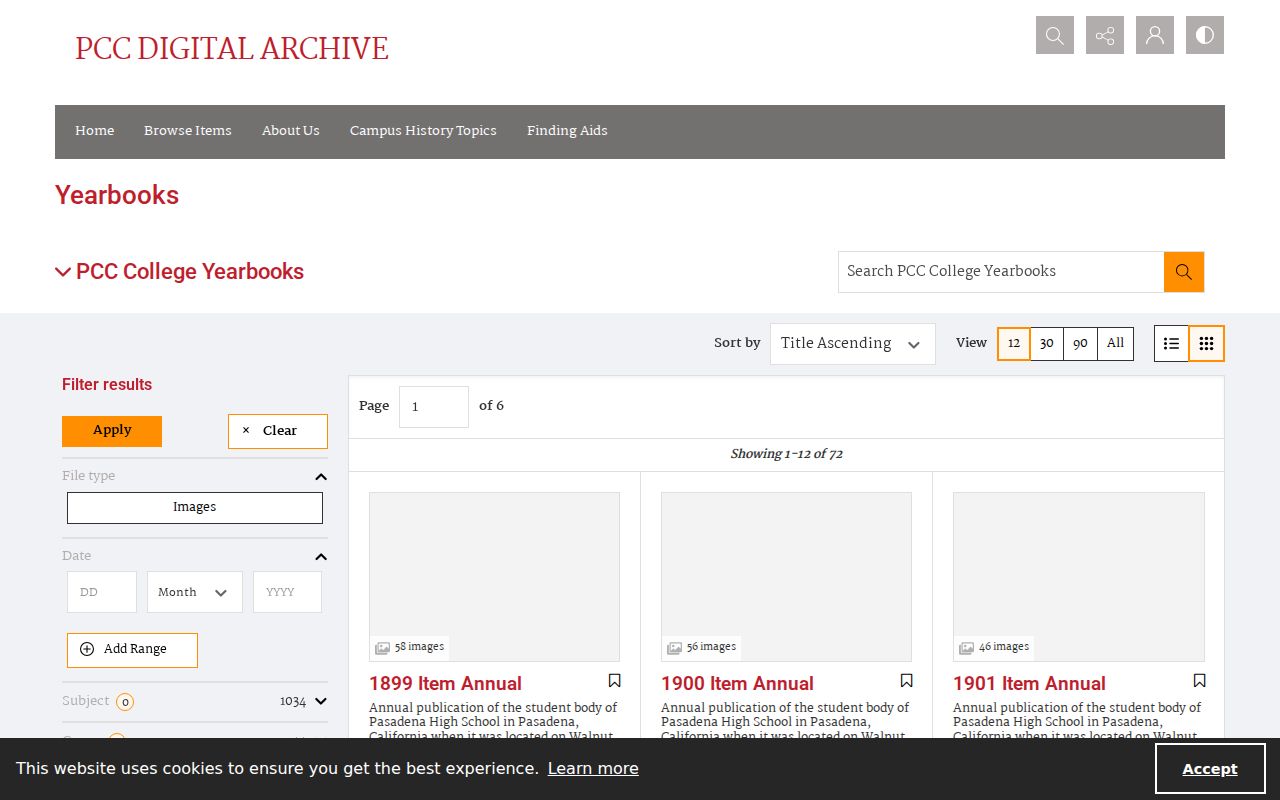
Use the yearbook for school affiliation and period context, then confirm an address through a directory, newspaper, or official record. The PCC archive also holds newspapers, staff directories, catalogs, photographs, club material, and institutional collections; physical archive appointments are arranged through archives@pasadena.edu on Tuesday or Thursday.
Pasadena Records, Newspapers, and Maps
Pasadena newspapers help explain a directory disappearance or a family move. The Pasadena Public Library News Index supplies citations back to 1880, but it chiefly identifies a title, date, and page rather than displaying every article. Staff and microfilm are the next step. The Pasadena Museum of History holds bound Pasadena Star-News volumes from 1886 to 1924 plus scattered local papers and clippings. Search names, initials, addresses, businesses, and common misspellings.
Sanborn maps test whether a building footprint or use continued across directory years. Pasadena coverage includes 1887, 1888, 1889, 1890, 1894, 1903, 1910 volume 2, and 1930 volume 7. The Library of Congress item record makes the 1887 to 1903 online sheet range discoverable, while PMH reports physical 1910 and 1931 sets.
A Sanborn sheet identifies structure, use, street naming, and outbuildings. It does not identify a resident. Pair a map with the volume, census, deed, or permit so that a building clue and a person clue remain distinct.
Pasadena Directory Access During Closure
Central Library's seismic closure changes how the earliest Pasadena city directory collections are reached. Nearly 10,000 Centennial Room items moved in 2025 to climate-controlled storage in a renovated former morgue. Staff research continues, with return expected in 2028. The Pasadena history page and the library's Ask Us service are the right starting points for a directory request, a scan question, a map, or a research consultation.
PMH remains a useful weekend fallback with its Friday through Sunday, 1 to 4 Research Library and Archives hours. The Altadena Historical Society can provide staff-assisted access to its 1911 to 1976 Thurston run. Ancestry Library Edition offers Pasadena volumes through participating PPL buildings, but remote availability is not promised. These channels let a search continue without calling an offsite catalog entry a complete digital run.
When requesting help, state the person's name, variant spellings, possible year, street or neighborhood, and the exact question. A focused request is easier to answer than a request for an unbounded list of everyone associated with an address.
Trace Pasadena Directory Households
A household trail is strongest when each directory year is treated as one frame in a longer sequence. Federal census schedules are public through 1950 under the 72-year rule. A directory immediately before or after a census can add an occupation, spouse, or address change, while the census supplies the household composition at its enumeration date. A later entry should not be projected backward or forward without an intervening source.
- Find the first likely entry and copy the complete line, including the street, spouse mark, occupation, and abbreviation.
- Check the prior and next directory editions for a move, widow notation, changed surname, or altered street label.
- Pair the sequence with the nearest census and note which facts belong to the census date rather than the directory date.
- Use the street section, Sanborn footprint, tax assessment, or permit trail to test whether the structure and address remained continuous.
- When a name disappears, search the News Index, obituary, probate, deed, or yearbook layer before deciding what happened.
The result should be a timeline with separate columns for person, address, source, structure, and confidence. If the modern question is an address-keyed one, shift to the Pasadena Street Directory page. If the historical match needs a current official cross-check, use the Pasadena Resident Lookup workflow.
Northwest Pasadena Records and Displaced Blocks
Some missing directory blocks reflect public works and displacement rather than ordinary household moves. Freeway construction displaced more than 3,500 Northwest Pasadena households. In 1960, 80 percent of Northwest Pasadena was people of color compared with 20 percent citywide. A later directory may therefore show an abrupt break in names and addresses even when the earlier block was a stable community.
Use neighborhood terms, newspaper citations, oral histories, preservation reports, and institutional archives when a street trail ends at a right-of-way or redevelopment period. The disappearance itself is a research clue, not proof that every family left at the same time. Treat names, race, relationships, and cause of displacement as facts that need a source, not as conclusions drawn from a surname or a blank page.