
Pasadena Sources Behind Previous Residents
A one-address history needs more than an owner name. The Los Angeles County Assessor supplies the parcel key. The Registrar-Recorder/County Clerk supplies recorded transactions, but only through an offline name and year index. Pasadena libraries and historical repositories supply household clues. Census schedules show a household at one enumeration date, while Sanborn maps test whether the building footprint and use fit the story.
| Source | Years It Covers | Where Held | What It Shows |
|---|---|---|---|
| LA County Assessor parcel roll | Current roll and parcel changes from the previous 24 months | Assessor Portal and GIS | AIN, situs, legal shorthand, land and building facts |
| RR/CC recorded real-estate records | 1850/1851-present | Norwalk index, counter, mail and copy channels | Grantor, grantee, recording date, document number and legal description |
| Pasadena Public Library directories | Going back to 1880 | Centennial Room, offsite storage and staff research | City and business entries, addresses, occupations and historical context |
| Pasadena Museum of History directories | Near-complete 1893-1976 | Research Library and Archives | Householders, addresses, occupations and directory changes |
| Federal census schedules | Public through 1950 | Historical schedules and library databases | Household composition at each enumeration date |
| Pasadena permits and cases | Current web system; older start not stated | Permit Center and Citizen Self Service | Projects, inspections, code cases and named applicants |
| Sanborn fire-insurance maps | 1887, 1888, 1889, 1890, 1894, 1903, 1910 vol. 2, 1930 vol. 7 | Library of Congress and PMH physical sets | Footprint, use, street naming and outbuildings, not residents |
| Historic property reports | 1906-07, 1910-19, 1919-35 examples | Pasadena preservation files and cited source books | Early assessor, tax, directory and building evidence |
Start with the source that matches the question. Use the parcel and deed chain for ownership, directories and census for previous households, permits for changes to the structure, and maps for continuity. A timeline that labels each result as ownership, occupancy, or building evidence is more reliable than a merged list.
Start With Pasadena Parcel Records
The Los Angeles County Assessor Portal is the first stop for a Pasadena previous residents search because it turns a street address into an AIN, or Assessor Identification Number. Record the situs address, legal-description shorthand, tract and lot when shown, and the current land and building characteristics. The Assessor map helps locate an adjacent or older parcel when an address has changed.
An assessor situs is the place enrolled for the parcel. It is not the same as an owner mailing address, and neither one proves who occupied the property. Owner names and owner mailing addresses are suppressed on the public web under California law. An owner lead may be obtained at an Assessor office or through Property Data Sales, then carried to the recorder's name and year index. The assessor map is not a boundary survey, and its internal legal shorthand is not the full acquisition deed description.
Note: AIN and legal description preserve continuity when a street address changes, splits into units, or appears under an older form.
Pasadena Deed Records at Norwalk
Los Angeles County does not publish an Internet index for its real-estate records. The index is arranged by grantor or grantee name and recording year, not by street address or AIN. County research describes the property holdings as beginning in 1850/1851 and uses 1851 onward for the historic viewing split. At 12400 Imperial Highway in Norwalk, 1851-1957 material is reviewed on the lower level, while 1958-present material is on the second floor.
The RR/CC viewing instructions document the offline route shown below. Appointment access to the index is free. The practical pivot is an identified name and year, not an open-ended request to find every deed tied to an address.
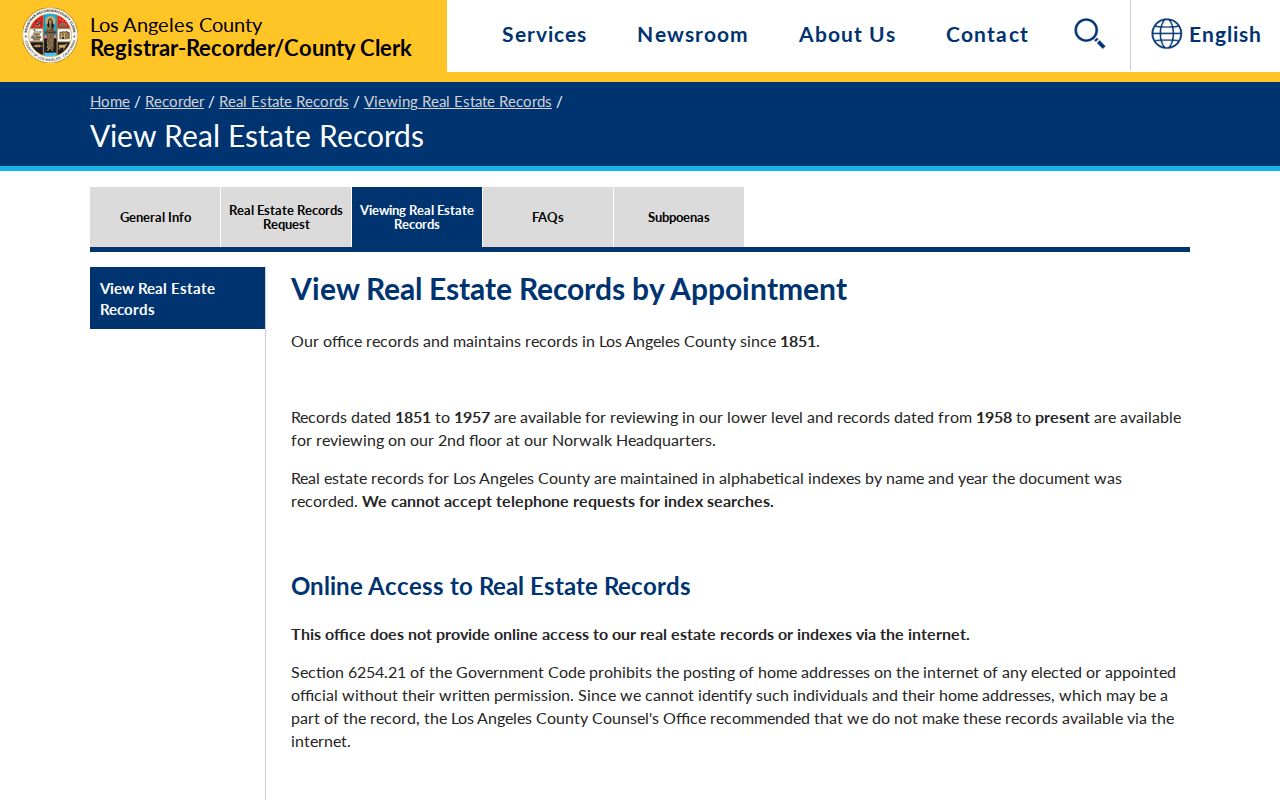
That lower-level and second-floor split is why a Pasadena previous residents project must allow time for an in-person search. The absence of a web result does not mean the deed is absent; it means the county's index is intentionally held at the records office.
Pasadena Deed Records by Request
Once a grantor, grantee, recording year, or document number is known, the RR/CC real-estate copy-fee schedule helps estimate the purchase. It is a fulfillment route, not a searchable deed index. A complete document must be purchased rather than selecting only a few pages, and processing is stated as within 20 working days.
The recorded-document request image below comes from the RR/CC real-estate records request page and shows the identified-copy path. In-person Norwalk research remains the best route for discovering an unknown prior owner. Mail goes to the Real Estate Records Section at P.O. Box 1130, Norwalk, CA 90651-1130. Online ordering uses the county's identified-record payment route. Staff can explain procedure at 800-201-8999, real-estate option 3, but will not perform an open-ended telephone index search.
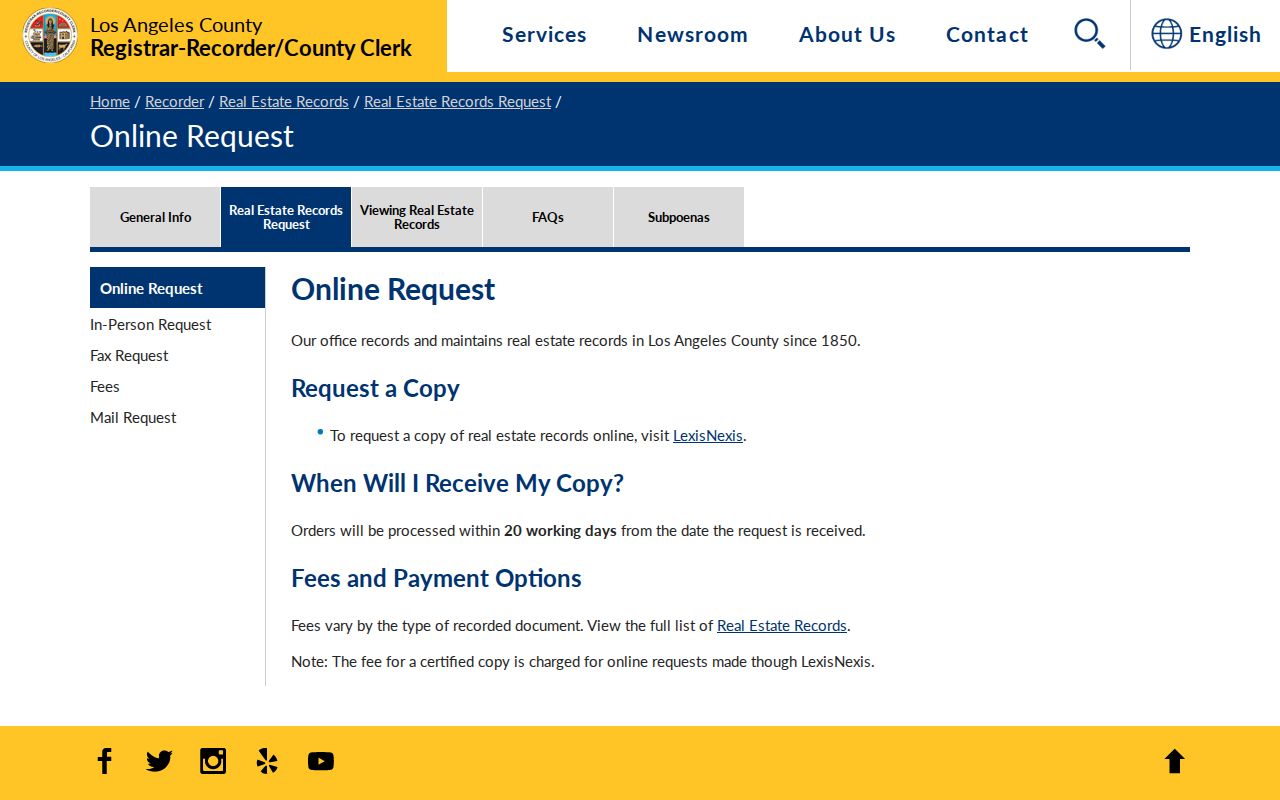
Copy charges depend on the copy type. The research lists a plain copy at $5 for the first page and $3 for each additional page, and a certified copy at $6 for the first page and $3 for each additional page. Branch convenience generally begins with identified copies from 1982-present, so historic Pasadena work belongs at Norwalk.
Walk Pasadena Deed Records Backward
The recorder's grantor-grantee method can turn one present parcel into a sequence of previous residents and owners, but only when the roles and years are kept straight. The RR/CC deed-search FAQ explains the name and year mechanics represented in the image below. A result can identify a document title, recording date, and document number; the purchased deed adds the parties and legal description.
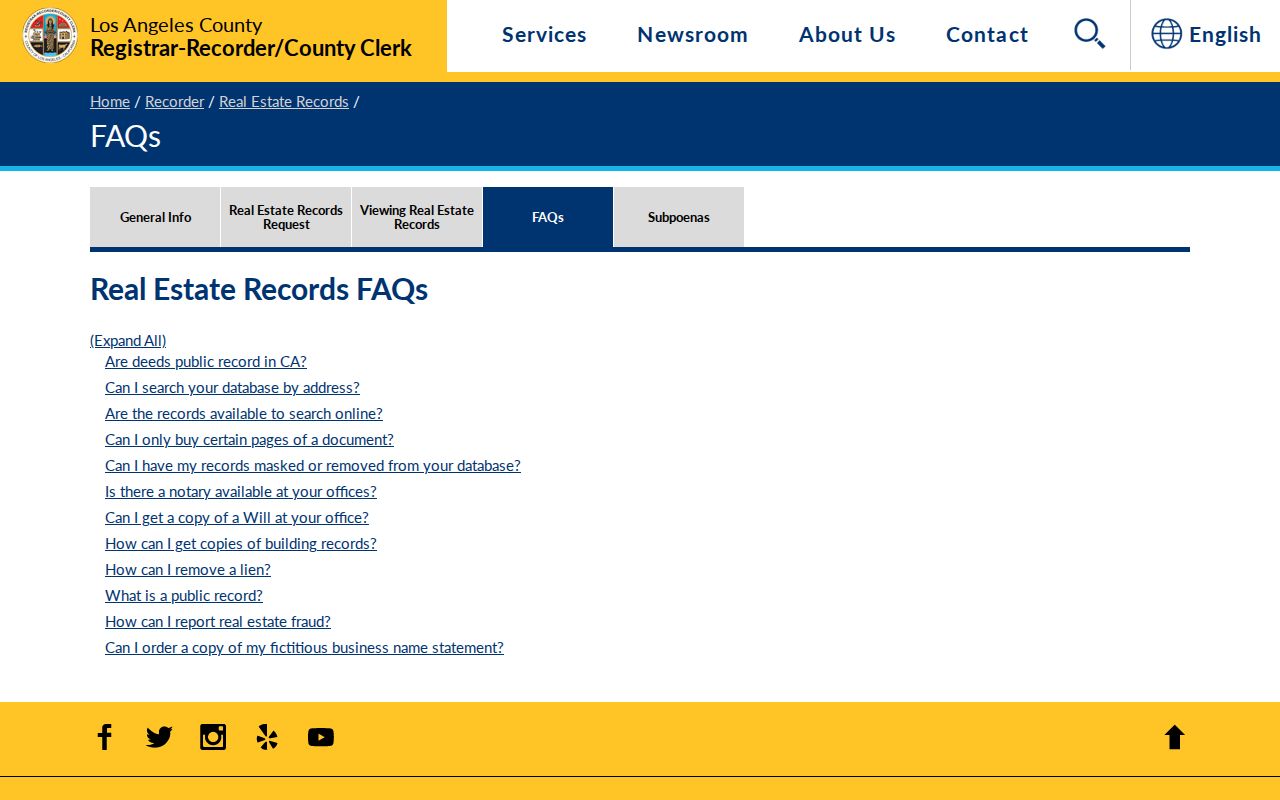
The image reinforces the key limit: there is no online address search to use as a shortcut. Move through the chain with the legal description and parcel continuity.
- Record the current AIN, situs, tract or lot shorthand, and obtain the owner lead through the Assessor's offline channel.
- At Norwalk, search the current owner as a grantee by the likely recording year and note the document number, date, title, grantor, grantee, and legal description.
- Take the seller named as grantor and search that person as a grantee in an earlier year. The same land description is the continuity test.
- Repeat backward, allowing for trusts, estates, name variants, joint parties, and changes in tract or lot language.
- Layer directories, census, permits, and maps over the ownership intervals so the deed chain is not mistaken for a list of occupants.
- Grantor
- The party transferring or conveying an interest in the recorded document.
- Grantee
- The party receiving the interest. In a purchase deed, the buyer is commonly the grantee.
- Chain of title
- The linked sequence of recorded transfers for the same land.
- Legal description
- The tract, lot, metes, bounds, or other land description that identifies what was conveyed.
Pasadena Directories Fill Household Gaps
Deeds show ownership transfers. Pasadena city directories can show a person or household at an address during the publication period, including a person who did not own the property. The Pasadena Public Library history collection reaches back to 1880 and includes directories, yearbooks, newspapers, maps, notebooks, and research help. Central Library material is offsite during seismic work, so Ask Us service and an appointment may be needed.
The Pasadena Museum of History Research Library and Archives reports a near-complete Pasadena directory run for 1893-1976, with research hours Friday through Sunday from 1 to 4 and staff contact through research@pasadenahistory.org. Altadena Historical Society holds a 1911-1976 Thurston run, which matters when older Pasadena directories include present-day Altadena or Lamanda Park. The digitized Moore Pasadena City Directory from 1900 and Thurston's 1918-1919 volume are useful samples, not replacements for every physical year. The Pasadena Directory Book explains how to read the collection itself.
Read the volume's key before expanding a line. A directory may mark a householder with “h,” a residence or room with “r,” and a spouse or widow with a separate convention. A missing name can mean a move, an omission, a coverage boundary, or a surname variation.
Pair Pasadena Directories and Census
Federal census schedules are public through 1950 under the 72-year rule. They supply household composition on an enumeration date, while a directory can bridge the years before or after that date. A directory entry is not a census and a census household is not a deed. Their value comes from overlap among address, spouse, occupation, and time.
- Choose a directory edition close to the census year and transcribe the exact name, address, occupation, spouse notation, and residence or householder mark.
- Search the matching census year for the address, street, household surname, and nearby place label. Keep the enumeration district, the area used by the census taker, with the result.
- Compare a prior and later directory to see whether the person stayed, moved, changed occupation, or appeared under a spouse or alternate spelling.
- Use permits, Sanborn sheets, and historic reports to test whether the structure existed at the same location during the claimed period.
- Write separate columns for owner, occupant, structure, and source date before calling a household one of the previous residents.
That directory-census flow is strongest for earlier Pasadena history. It should not carry a 1950 household forward into later decades without an intervening directory, deed, newspaper, permit, or other dated record.
Pasadena Sanborn Maps for Past Residents
Sanborn fire-insurance maps test building continuity rather than identity. Pasadena sets include 1887, 1888, 1889, 1890, 1894, 1903, 1910 volume 2, and 1930 volume 7. The Library of Congress has 1887-1903 sheets online; its later catalog records cover 1910 and 1930 without online viewing, while PMH reports physical 1910 and 1931 sets. The Library of Congress Sanborn collection is the correct starting point.
The map series grew from five sheets in 1887 to 115 in 1930. A sheet can show a footprint, construction or use clue, street name, and outbuilding. It cannot identify a resident. Pair the map with a dated directory, census, deed, permit, or preservation report. If a later building sits on an older footprint, the map may explain why an address story contains two structures.
Note: A Sanborn footprint supports a building timeline, not a claim that a named person lived there.
Pasadena Garfield Heights Records Before 1904
A Pasadena historic survey supplies a local warning about missing city records. Pasadena incorporated on June 19, 1886, but one Garfield Heights house predates the city's 1904 annexation of the area. An original city building record therefore does not exist for the house's earliest period. The absence is geographic and administrative, not proof that the property had no history.
Researchers rebuilt the trail with 1906-07 assessor field books, 1910-19 tax assessments, and 1919-35 directories. The Pasadena historic correspondence shows why those sources belong together. A tax assessment can establish an improvement or value, a directory can identify an occupant, and a later city file can preserve the citation path even when the first permit is outside the city record system.
For a Pasadena previous residents project, annexation is a search instruction: expand the record set and search the pre-annexation place label before deciding that a gap is a dead end.
Pasadena Past Residents and Grand Avenue
A cited Pasadena historic report places George B. Post at 257 Grand Avenue in the 1900 directory, but the current house on that property dates to 1918. Later evidence places Post at 350 S. Grand in 1908, while the 1910 census places him at 657 S. Grand. The sequence is a direct warning against treating one printed address as an unchanged structure.
Use the Grand Avenue example as a test for every address history. Compare the edition year, direction, street section, census location, parcel description, and building footprint. If the address moves, the person may have moved, the numbering may have changed, or the later house may not be the same building. The safest conclusion is a dated association, not an automatic claim that the same house held the same household.
Close Pasadena Previous Residents Research
Once the deed chain and household timeline are stable, use Pasadena's News Index, bound Pasadena Star-News material, obituaries, probate references, permits, and preservation reports to explain arrivals and departures. An obituary can connect a former address to relatives. Probate can identify a decedent, petitioner, executor, or named heir. A permit can date an alteration. None should be treated as a current-residence statement without a matching date and source.
The finished result should read as a sourced sequence: parcel and AIN, identified deed, prior grantor and grantee, directory household, census household, structure evidence, and a closing newspaper or probate clue. When a name disappears, check a place-name change, annexation, freeway displacement, address normalization, or building replacement before assuming an ordinary move.
Lawful house history. Pasadena previous residents research fits family history, preservation, genealogy, estate work, and personal curiosity. Do not use a record trail to stalk, track, harass, or intimidate a living person. Public access is not permission to intrude.
Note: The strongest house history reports what a record associates with an address, date, role, or structure, and leaves unsupported identity claims out.